
Core Drilling in Dubai: How to Plan a Concrete Opening Before Drilling
When a construction project needs a new opening through a concrete wall or slab, core drilling in Dubai can provide a precise solution for suitable plumbing, HVAC, electrical and MEP requirements. The drilling itself is only one part of the job. Choosing the right location, opening size, drilling method and site preparation can make a major difference to the project.
For contractors, MEP teams, engineers and property owners, proper planning before drilling can help avoid unnecessary cutting, delays and problems with surrounding construction.
FastCore Technical Services L.L.C. S.O.C. provides professional concrete cutting, core drilling and demolition services for suitable construction, renovation and commercial projects across Dubai and the UAE.
This guide explains what should be considered before arranging concrete core drilling and what information can help a contractor understand the job accurately.
What Is Core Drilling?
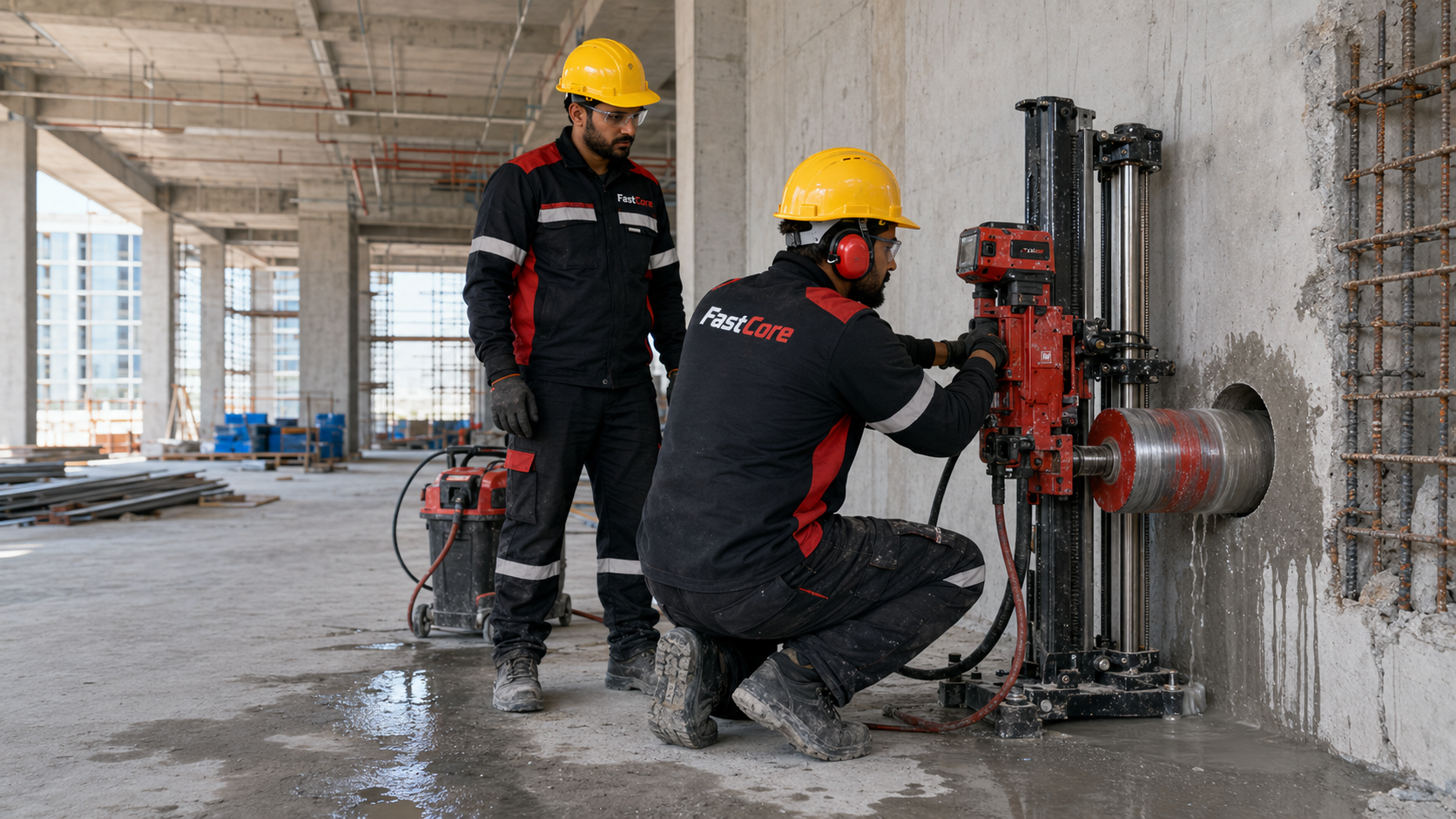
Core drilling is a method used to create a circular opening through suitable concrete or masonry using a diamond core drilling system.
Unlike breaking concrete with conventional demolition equipment, core drilling is designed to produce a defined cylindrical opening.
Depending on the project, these openings may be required for:
- Plumbing pipes
- Drainage systems
- Electrical conduits
- HVAC installations
- Mechanical services
- Ventilation
- MEP penetrations
- Other planned construction requirements
The appropriate drilling method depends on the structure, access conditions, opening requirements and project specifications.
Why Planning Matters Before Core Drilling
A concrete opening should not simply be drilled wherever it appears convenient.
The location may need to work around existing construction, reinforcement and building services. The required diameter and depth also need to match the installation that will pass through the opening.
Good planning helps answer important questions before work begins:
- Where exactly is the opening required?
- How large does it need to be?
- How thick is the concrete?
- Is the opening through a wall or slab?
- Are existing services nearby?
- Is reinforcement present?
- Can the drilling equipment access the location?
- How will water and drilling slurry be managed?
- Is the site occupied or under active construction?
- Does the proposed opening require approval from the responsible project professionals?
These details can make the quotation and site planning much more accurate.
1. Determine the Required Hole Diameter
The first step is understanding what needs to pass through the concrete.
A plumbing pipe, drainage connection, electrical conduit or HVAC-related service may require a different opening size.
The hole should not automatically be made larger than necessary.
The required diameter should be based on the actual installation requirements and any clearance specified by the relevant project professional.
Providing the approximate diameter when requesting a quotation can help the drilling contractor understand the scope.
2. Identify the Concrete Wall or Slab
The drilling location is another important consideration.
Is the opening required through:
- A reinforced concrete wall?
- A floor slab?
- A ceiling or overhead concrete element?
- Another suitable concrete structure?
Different locations can present different access and working conditions.
For example, overhead drilling may require additional planning compared with drilling at floor level. A wall in a completed commercial space may also require greater attention to protecting nearby finishes.

3. Consider the Concrete Thickness
Concrete thickness affects the drilling requirements.
Before arranging core drilling services in Dubai, try to establish the approximate thickness of the wall or slab if that information is available from drawings or site records.
If the thickness is unknown, photographs, drawings or a site assessment may help determine the appropriate approach.
Accurate information is especially useful when a project involves multiple openings with different depths.
4. Check the Proposed Drilling Location
The exact position of the opening matters.
A core hole may need to align with a pipe, cable, duct or other service on the opposite side of the wall or below a slab.
The location should therefore be coordinated with the relevant installation team before drilling.
For renovation projects, this can be particularly important because the building may already contain concealed services.
5. Consider Reinforcement and Existing Services
Concrete structures can contain reinforcement and existing building services.
Before drilling, the project team should consider what may be present around the proposed opening.
Depending on the project, suitable investigation or scanning may be required before drilling.
The responsible engineer or project professional should determine whether the proposed opening is acceptable and what checks are required.
Core drilling should not be treated as a substitute for structural assessment or engineering approval.
6. Plan for Plumbing and Drainage Openings
Plumbing and drainage projects commonly require planned penetrations through concrete.
A core hole may provide a defined route for a pipe through a suitable wall or slab.
Before drilling, the plumbing team should know:
- Required pipe size
- Required opening location
- Required direction
- Approximate penetration depth
- Connection requirements
This coordination can help prevent situations where the hole is drilled correctly but does not align with the final installation.
7. Plan for HVAC and Mechanical Services
HVAC and mechanical installations can also require concrete penetrations.
Depending on the system, an opening may be needed for a pipe, service connection or other component.
For commercial fit-outs and renovation projects, the drilling location should be coordinated with the MEP layout before work begins.
This is particularly important when several contractors are working in the same area.
8. Plan for Electrical and MEP Work
Electrical conduits and other MEP services may require openings through existing concrete construction.
The drilling contractor should receive clear information about the intended opening wherever possible.
For larger projects, drawings and coordinated MEP layouts can be especially useful.
The objective is simple: create the opening where the service actually needs it, rather than drilling first and solving the installation problem afterward.
9. Think About Site Access
Core drilling equipment needs suitable access to the work location.
A project may have limited space because of:
- Existing equipment
- Temporary structures
- Furniture
- Scaffolding
- Other contractors
- Narrow access routes
- Finished interiors
When requesting a quotation, photographs of the work area can help the contractor understand the site conditions.
If access is restricted, this should be mentioned before scheduling the work.
10. Plan Water and Slurry Management
Many concrete drilling applications use water during the drilling process.
This means the project should consider where the water and resulting slurry will go.
On finished floors, commercial interiors or occupied buildings, uncontrolled water can create unnecessary cleanup problems.
A suitable site plan should therefore consider:
- Nearby finished surfaces
- Drainage availability
- Water containment
- Slurry collection
- Protection of surrounding areas
- Final cleanup
The exact approach depends on the site and drilling conditions.
Core Drilling in Existing Buildings
Core drilling is particularly useful when an existing building needs new service penetrations.
Renovation and refurbishment projects may require new:
- Plumbing routes
- Drainage connections
- HVAC services
- Electrical conduits
- Mechanical installations
- Other building services
Instead of removing a larger section of concrete, a planned circular opening may provide the required penetration for the installation.
However, the proposed location should be checked against the existing building conditions before drilling.
Core Drilling vs. Concrete Cutting
Core drilling and concrete cutting are related services, but they are used for different purposes.
Core drilling is generally used when a circular opening is required.
Concrete cutting can be used when a straight cut, section removal or larger opening is required.
For example:
Pipe penetration → Core drilling
Circular service opening → Core drilling
Doorway or large rectangular opening → Concrete cutting / wall sawing
Removing a defined section of slab or wall → Appropriate concrete cutting method
Choosing the correct technique starts with understanding the finished result required by the project.
For a broader overview of FastCore’s concrete cutting, core drilling and demolition services, visit the Services page.
What to Send When Requesting a Core Drilling Quote
You do not need to know every technical detail before contacting a contractor.
However, providing the following information can make the initial discussion much easier:
- Project location
- Number of openings
- Approximate hole diameter
- Approximate concrete thickness
- Wall, slab or other location
- Purpose of the opening
- Site photographs
- Available drawings
- Access conditions
- Preferred work schedule
If the exact diameter or depth is unknown, explain what needs to pass through the opening.
A professional contractor can then review the available information and determine what additional details may be required.
Common Core Drilling Planning Mistakes
Drilling Before Confirming the Location
A correctly drilled hole in the wrong position is still a problem.
The location should be coordinated before drilling begins.
Choosing the Hole Size Without Checking the Installation
The opening should be based on the actual service requirement rather than guesswork.
Ignoring Existing Services
Existing electrical, plumbing or mechanical services may be present within or around the proposed drilling area.
Forgetting About Site Protection
Water, slurry and concrete dust should be considered before work starts, particularly inside finished buildings.
Not Providing Enough Site Information
A few clear photographs can often communicate important information about access and the working environment.
A Simple Pre-Drilling Checklist
Before booking core drilling in Dubai, review these points:
- Confirm the purpose of the opening
- Confirm the approximate hole diameter
- Identify whether it is a wall or slab
- Confirm the approximate concrete thickness
- Mark the proposed drilling location
- Coordinate with the relevant MEP team
- Consider reinforcement and existing services
- Check equipment access
- Plan water and slurry management
- Protect nearby finished surfaces
- Share photographs or drawings
- Confirm the required work schedule
This preparation can make the job easier to quote, schedule and coordinate.
Core Drilling Services in Dubai
FastCore Technical Services L.L.C. S.O.C. provides suitable core drilling services in Dubai for construction, renovation, commercial and industrial applications.
Our concrete-related services include:
- Concrete cutting
- Diamond core drilling
- Controlled demolition
- Suitable wall and slab cutting applications
Each project is different, so the required equipment and method should be determined according to the actual site conditions and scope of work.
For larger or more complex projects, coordination with the responsible engineer, contractor and MEP team is important before drilling begins.
You can also explore FastCore’s completed projects to see examples of the type of concrete-related work the company handles. Visit the Projects page.
Serving Dubai and the UAE
FastCore operates from Al Quoz Industrial Area 4, Dubai, and serves suitable projects across Dubai and the UAE.
Core drilling requirements may arise in commercial buildings, villas, warehouses, industrial facilities, fit-out projects and renovation work.
Projects can be discussed in Dubai and other UAE emirates depending on scope, access and scheduling requirements.
Need Core Drilling in Dubai?
Planning a concrete opening for plumbing, drainage, HVAC, electrical or another construction requirement?
Before drilling begins, make sure the location, size, access and surrounding conditions have been properly considered.
FastCore Technical Services L.L.C. S.O.C. can discuss your project requirements and determine the appropriate concrete drilling or cutting approach.
Learn more about FastCore Technical Services L.L.C. S.O.C. and the company’s concrete-related services.
Ready to discuss your project? Contact FastCore with your project location, required openings and available site information.
FastCore Technical Services L.L.C. S.O.C.
Street 7, Al Quoz Industrial Area 4, Dubai, UAE
+971-55-643-4312
fastcoretechnicalservices@gmail.com
24 Hours • 7 Days
PRECISION CUTTING • POWERFUL RESULTS
Frequently Asked Questions
What is core drilling used for?
Core drilling is used to create circular openings through suitable concrete or masonry for applications such as plumbing, drainage, HVAC, electrical and other MEP services.
Do you provide core drilling services in Dubai?
Yes. FastCore provides suitable core drilling services for construction, renovation, commercial and industrial projects in Dubai.
Can core drilling be used on concrete walls?
Yes, suitable concrete walls can be core drilled when the opening has been properly planned and the site conditions allow the work.
Can concrete slabs be core drilled?
Yes. Suitable concrete slabs can be drilled for planned service penetrations, subject to project requirements and relevant structural considerations.
How do I know what hole size I need?
The required opening should be based on the service or installation that needs to pass through the concrete. Your MEP contractor, engineer or installation professional can provide the required dimensions.
Should existing services be checked before drilling?
Yes. Existing reinforcement and concealed services should be considered before drilling. The responsible project professional should determine whether scanning or other investigation is required.
What information should I provide for a quotation?
Project location, number of holes, approximate diameter, concrete thickness, drilling location, purpose of the opening and clear site photographs are useful starting information.
Is core drilling the same as concrete cutting?
No. Core drilling normally creates circular openings, while concrete cutting can be used for straight cuts and other defined concrete removal requirements.
Can core drilling be used during renovation?
Yes. Core drilling can be useful when new building services need to pass through existing concrete during renovation and refurbishment projects.
Do you provide services outside Dubai?
FastCore can discuss suitable projects across the UAE depending on the project scope, location and schedule.
Final Thoughts
Successful core drilling starts before the drilling machine reaches the concrete.
When the opening location, dimensions, access, existing construction and service requirements are properly coordinated, the work can be planned more efficiently.
For contractors and project teams looking for core drilling in Dubai, providing clear site information is one of the simplest ways to start the process.
Contact FastCore Technical Services L.L.C. S.O.C. to discuss your concrete drilling, core cutting or related project requirements.